


Northern Hemisphere – Hellenic Centre for Macedonian Studies
Geopolitical implications of the Prespa Agreement
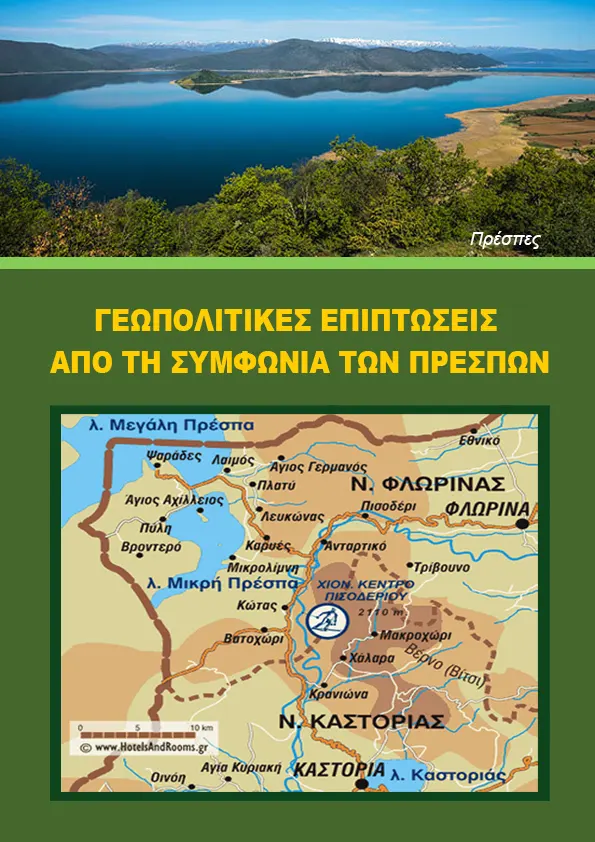
From the outset, the Passover Agreement was based on the following specifications:
· The FYROM would make changes to its Constitution, as foreseen by the “Prespes”.
– The main change was that of the constitutional name from “Republic of Macedonia” to “Republic of North Macedonia”.
– The Agreement also stipulated that references to irredentism or minority claims in the Constitution would be removed or amended.
– Finally, it cancels Skopje’s explicit usurpation of ancient Macedonian heritage.
Language, citizenship, Macedonian people and Macedonian nation
With the diplomatic (verbal) note, however, which followed and Greece accepted without complaint, Greece gives language, citizenship and people.
In the diplomatic note, the term “Macedonian” people is mentioned for the first time. The change of the name of the Former Yugoslav Republic of Macedonia (to “North Macedonia”) is practically negated by the fact that, under the Agreement, the people of the neighbouring country will be called “Macedonian” (and not “North Macedonian”).
The verbal communication explicitly refers to ‘Macedonian’ people. Something that Greece has never accepted before. It is obvious that the Slavs of FYROM want through the name “Macedonian” to legitimize their ideology of a “Macedonian nation”. This is amply demonstrated by the fact that there are references to the “Macedonian people” in the amended Constitution as well.
– The recognition by Greece of the existence of a ‘Macedonian language’ works in the same direction. With the Prespa Agreement, Greece recognises in Article 1.3 a ‘Macedonian language’, with the explicit and inaccurate reference that it had been recognised as such since 1977. This creates many problems: Since Skopje also recognizes that its language belongs to the family of South Slavic languages, why then, did the Tsipras government not demand that it be called Slavo-Macedonian? The Slavs had every interest in getting what was eventually passed, because their aim was to legitimise through the Prespa Agreement the ideology of Macedonianism, which is what happened. As a leading American internationalist commented, it is obvious that any Slav in a neighbouring state will be able to declare, by showing his Greek-legalised passport, that he is a “Macedonian” and speaks “Macedonian”. He will not add “you know I am a citizen of North Macedonia” and that “my language belongs to the family of the South Slavic languages”!
– On the other hand, with the ratification of the Agreement, the recognition of such a language (without specification) will also become effective in the internal law of Greece. Article 1.8 of the Agreement states: “From the entry into force of this Agreement […] the Parties shall use the name and terminology of Article 1.3 for all uses and purposes erga omnes, i.e., internally, in all their bilateral relations and in all regional and international organizations and institutions”. Erga omnes does not only concern the FYROM. The Agreement refers to the “Parties”. Therefore, this name is erga omnes for Greece as well. And it is wrong to claim that Greece can call this language differently. The government side is “reassuring” the Greek people with inaccuracies. In this way, it has tried to bind-lock Athens.
– Also, the term nationality, which will be written on passports, can be translated both as nationality and citizenship. If there were no second thoughts on the part of Skopje, the term citizenship, which clearly means nationality, could well be used. In other words, it is clear that the Slavs of the neighbouring country will take advantage of the possibility offered by the double meaning of nationality to claim that they are ethnically Macedonian. But even if one accepts that nationality refers to citizenship and not to ethnicity, then why is citizenship called “Macedonian” and not North Macedonian?
Citizenship is the legal relationship between a citizen and the state. In all countries of the world, without exception, the name of citizenship is a derivative of the state name. Why was this rule violated in this particular case? Why did the Tsipras government accept it? Indeed, it is surprising that Athens could take advantage of the fact that the Albanians of FYROM, for obvious reasons, would prefer to have citizenship written on their passports: North Macedonian. Nikos Kotzias, however, did not use this leverage on the Zaev-Dmitrov duo to ensure the obvious. What is true in all countries of the world without exception. The question of the legitimacy of the Constitutional Review arises
As regards the constitutional revision, there is a question of legitimacy, since it bears the signature of the Speaker of the Parliament and not of President Ivanov, as provided for. This was done because President Ivanov categorically refused to sign.
Since his term of office expires next year, the process could be frozen in order to allow the new Constitution to be signed by the new President of the Republic. Such a delay was against political expediency in both countries, which is why we have been led to this irregularity, which a VMRO government might invoke in the future.
Another problematic point is the fact that the amendments were sent without the final text of the amendments being sent. How do they get into the text? This raises an important issue: How can MPs vote on a text that is not yet in its final form? It is indeed inconceivable that the single text of the Skopje Constitution, which is a prerequisite for discussion, has not been deposited.
Article 36 violates the Agreement
The publication of the text of the verbal warning has confirmed that the Slavs of FYROM have also acted in bad faith with regard to the constitutional changes. The term “Macedonia” and its derivatives remain in Article 36 of the Constitution. Zoran Zaev offered the excuse that this reference has a historical dimension: “The Republic guarantees specific social security rights to veterans of the anti-fascist war and all “Macedonian” national liberation wars, to war invalids, to those expelled and imprisoned for the ideas of the separate identity of the “Macedonian people” and “Macedonian” statehood, as well as to members of their families without means of material and social subsistence. These rights are regulated by law”. Has the Tsipras government asked itself what these “Macedonian” national liberation wars are? Obviously it refers to the claim to Greek Macedonia.
In the Constitution there is an explicit reference to the “Macedonian state” [MakeдOHckиOT ApaBHOCT]. This is a clear violation of the Prespa Agreement, which stipulates: “The offensive designation for the state, its official organs and other public entities shall be aligned with the official name of the Second Party or the short name, namely the Republic of North Macedonia or North Macedonia” (Article 1.3.g).
The problem, however, lies mainly in the references to “Macedonian people”. In particular, on page number 2 there is a clear reference to. “The Republic (of North Macedonia) shall protect, guarantee and enhance the characteristics and historical and cultural heritage of the Macedonian people”. Reference is also made to the “Macedonian people” of the diaspora, for whom care should be taken: “The Republic will provide for the diaspora of Macedonians, the Macedonian people and part of the Albanians, Turks, Vlachs and others, promoting ties with the homeland.” In total there are three references to “Macedonian people”, which may open a backdoor for future interpretations.
After five years the name change
Article 3 stipulates that official and public administration documents for international use will be adapted to the new name within five(!) full years, while Article 4 stipulates that official and other public administration documents for internal use will also be changed within five years, but starting from the opening of the corresponding chapter of the EU accession process! I wonder why the Tsipras government accepted this irrelevant interconnection?
“Macedonia” and “Macedonian” in Article 7
However, it should be noted that the same Prespa Agreement includes Article 7. In it, the two countries agree to use the terms “Macedonia” and “Macedonian” with reference to different historical context and cultural heritage. For Greece, according to Article 7(2) this includes not only Northern Greece, but also Greek culture, history and heritage. FYROM commits in Article 7(3) that in these terms it defines a different tradition and heritage and in Article 7(4) it commits that all this has nothing to do with the ancient culture and heritage and culture of Greek Macedonia. Article 7 of the Agreement partially solves the problem of the Macedonian Slavs’ usurpation of the ancient Macedonian heritage. Certainly, this is not a definition of citizenship. It is a definition of identity.
There remains the question of Macedonian minorities
The current Article 49 of the Constitution states: “The Republic shall take care of the status and rights of persons belonging to the Macedonian people in neighbouring countries, as well as Macedonian expatriates, shall assist their cultural development and promote ties with them. The Republic takes care of the cultural, economic and social life and insurance rights of the citizens of the Republic abroad.” This amendment will replace Article 49 and Amendment II in the Constitution of the Republic of Macedonia.
The problems arising from this amendment are that it maintains the distinction between Macedonian citizens residing abroad and “Macedonians” who also reside outside the borders of the country. The change that is being attempted is completely hypocritical. Instead of ‘Macedonians’ residing in neighbouring countries, the reference is to ‘Macedonians’ residing abroad, which obviously includes, of course, neighbouring countries. If they were not acting in bad faith, the Constitution should refer to diaspora or expatriates. In other words, it is a crucial article one that essentially refers to whether and to what extent the FYROM side raises issues of “Macedonian minorities in neighbouring countries.
Finally, as stipulated in the Prespa Agreement, in order for Greece to start ratifying the Agreement and the NATO accession protocol, the FYROM must complete all internal procedures in their entirety. And, indeed, in full. Nevertheless, the FYROM is trying to unilaterally change the Agreement by means of an explanatory amendment. It stipulates that the changes to its Constitution are being voted on now, but will come into force after (a) the ratification of the Prespa Agreement by Greece and (b) the protocol on FYROM’s accession to NATO. This is exactly what the eight VMRO MPs had asked for when they broke away and voted in favour of constitutional reform. This is a clear violation of the Prespa Agreement.
Prespa Agreement. What changes and what remains the same?
Changes
– Name:
– Constitution.
– Changes. In public institutions.
– Distinction of Ancient History of Greek Macedonia and North Macedonia.
Without change.
– Citizenship: Macedonian/Citizen of North Macedonia
– Language: Macedonian, without asterisks
Historical background: From the 19th century to the Prespa agreement.
– Skopje, a spillover of the Macedonian issue from the Berlin Treaty, 19th century.
– After World War II, the issue re-emerged between Greece, Bulgaria and Yugoslavia.
-“Skopiano” or “Macedonian”: the dispute between Greece and the former Yugoslav Republic of Macedonia over the name and the use or not of the term “Macedonia”.
– Controversy also over the term “Macedonians” in the self-definition of Slavo-Macedonians.
– UN interventions and proposed solutions as: North, Upper, New, etc.
1990s
– Independence from 1991 of FYROM and pressure from Greece for the new flag. – In 1992 Greece on the name rejects the term “Macedonia” or its derivatives through the Council of Political Leaders.
– In 1993 the provisional name of FYROM was recognised without a flag. In 1994, under Andreas Papandreou, an embargo was imposed.
– In 1995 there was the interim agreement recognizing borders, provisional name Fyrom, change of flag and currency, no claims on Greek territory, Greek veto on membership in international organizations and lifting of the embargo.
From 2000 to date
– In 2004 the US recognized the constitutional name “Republic of Macedonia”.
– In 2007 Greece postponed NATO membership if a solution to the name was not found.
-Greece makes a declaration of acceptance of a composite name with the term “Macedonia” as the second synonym.
– In 2008 the Parliament agreed to a composite name.
– At the Bucharest Summit, Greece vetoed the accession of a neighbouring country to NATO.
– In 2011, FYROM makes an oral appeal to the Hague Court of Justice – Greece is condemned.
– The name issue returns to the fore in late 2017, on the occasion of the NATO Summit, at which the FYROM government accepts the composite name.
– Negotiations 2018 with Nimitz and Greece in favour of geographic or temporal designation in Slavic, single.
– On 12 June 2018, the two countries agreed on “Republic of North (Severna) Macedonia”.
Prespa Agreement: The pros and cons of a historic agreement
(What Deputy Minister of Foreign Affairs, G. Vasilievich, says in response. Katrougalos, lawyer A. Vγόνtzas and academics D. Xenakis and M. Achimastos? Two professors of the University of Crete, Dimitris Xenakis from the Department of Political Sciences and Myron Achimastos from the Department of Sociology, gave their own answers, on the TV air of “Crete TV”, in the context of the show “Free Point” with Lefteris Συμβoulakis).
The two professors argued against each other, each supporting a different point of view, while in the context of the same programme, the Deputy Foreign Minister George Katrougalos, who argued that Greece had achieved the best possible agreement, and the lawyer and director of the Legal Office of the Prime Minister under Andreas Papandreou, Antonis Vogontzas, who had experienced the imposition of the Greek embargo on Skopje and the interim agreement in 1994 and 1995. The two professors from the University of Crete clashed, espousing two diametrically opposed views.
Sociology professor Myron Achimastos argued that it was a good agreement, that a long-standing problem had been solved and that we had gained a friend in the north in terms of solidarity, economic cooperation and co-development, stressing that Macedonia is not one, but Greek Macedonia is Greek. He described the agreement as balanced and stressed that Russia and Turkey did not want it, because they wanted more infiltration, which would create even more tension in the Balkans and promote nationalism.
On the contrary, Professor Dimitris Xenakis of the Department of Political Science argued that the agreement is not as good as it seems and that this will be proven in the future. With this agreement we open the window of using the term “Macedonian”, “Macedonian”, “Macedonian” in a number of issues that can create problems. “Irredentism is fed by the agreement because it does not solve problems, for example, economic problems and the markets of Europe, which will be confused by the common name of our products,” he said.
“They open doors with risks”
Legal expert and director of the Prime Minister’s Legal Office under Andreas Papandreou, Antonis Vogontzas, was also catalytic in his interventions. Mr. Vγόνtzas said, among other things. This is the first time I have ever seen a US president so openly interfering in a referendum of such a small state. First time I have seen the Chancellor, who has brains and knowledge and lived in East Germany, thanking Tsipras for reaching an agreement that does not serve Greece. Without the will of Greece, none of these events, whether self-admission to NATO or lengthy EU accession processes, would have happened.
Since 1995 to date we have increased diplomatic relations and trade agreements. So those who claim recognition by other states are not saying anything. It is certain, we are an independent state and with our veto no state can enter NATO.”
Mr. Vγόνtzas went on to mention some dark interests in the Balkans, which act as a mafia and have nothing to do with nationality and ethnicity. “It is something more sinister. When the Prime Minister uses the term ‘self-definition’, he puts a torpedo in the… Greece’s reefs. Erdogan can also raise issues in Thrace. It opens doors for dangers and dangerous winds that we will not be able to contain,” he pointed out.
Deputy Foreign Minister George Katrougalos, in a brief intervention during the broadcast, set the government’s tone on the Prespes agreement a few hours before its ratification.
Mr. Katrougalos made the following statements, which were shaped by the interventions and questions of Mr. Vogonza during the televised dialogue:
“This is the best possible agreement we can have. The mere fact that we are improving provisions of the Constitution that had been amended on the basis of the interim agreement but did not satisfy the Greek position, gives the measure of the truth of my claim. Throughout the whole range of the national line at least from 2007 onwards, a composite name specifying the name of the neighbouring country against all (erga omnes), geographical designation and a change in its constitution was what was practically pursued from 1993 to the present day.
In 1993, I recall, shortly after the Council of Heads of State, it was proposed by us, through our then Permanent Representative to the United Nations, to establish Slav Macedonia and various variations from there to the present day. So we have achieved what Greek diplomacy has been striving for 30 years in the best possible way. In the past we had many cases of violation of the Interim Agreement, which were also raised on our behalf at the Hague Tribunal when the issue came up. There, of course, it was ruled that we had violated an obligation arising from the interim agreement in relation to our refusal to join NATO, which we did not actually do because of the veto.
My answer as to whether we can expect compliance and agreement and good implementation of the Prespa agreement… I should mention that we now have two better and qualitative facts: a) a better agreement, which solves the issue once and for all, and b) the agreement is accompanied by a name and constitution change. And I would add that the first four amendments were in implementation of the interim agreement.
We considered that they did not meet our national interests, and therefore we improved them with this one. It removes the poison of nationalism on both sides of the border, and in the future our positions will be characterised by friendship and not by undermining interests. Our foreign policy as a country has not had aggressive characteristics, but at the recent rally in Thessaloniki I heard ‘to arms, to arms, let us take Skopje’.”
THE PROS AND CONS OF THE PRESPA AGREEMENT
By Michael Rettos
Published: 24/01/2019COGNOSCO BLOG / Michalis Rettos
Michalis Rettos is a graduate of Classical Philology at the University of Athens and specializes in the MSc “Modern and Contemporary Greek History” at the University of Athens.
“Before taking a position on the issue of the “Prespes Agreement” it is good to have an understanding of the arguments of the other side. This inability to understand the opposing position leads to aphorisms, extremes and divisive logics. The above is compounded by the government’s insistence on passing the agreement ‘just because it wants to’ – in the absence of essential democratic legitimacy -, an insistence that is perhaps also linked to the desire to serve transatlantic interests in the region. If democratic legitimacy is considered the four-year practice (of an elected monarch) of passing bills by 151+ pawns (the word is used purely descriptively, not pejoratively), with the majority of the popular body opposing, then surely we should reconsider the concepts.
This paper will present the arguments “for” and “against” the agreement as they are presented in the public debate. Anyone can weigh these up to form their own position, but with knowledge of the opposing viewpoint.
Arguments in favour of the ‘Prespa Agreement’:
1. The ‘Prespa Agreement’ fulfils the conditions concerning the name of FYROM, which the Greek side has set since 2007 as a ‘national line’: a composite name with erga omnes geographical designation.
2.The granting of Macedonian citizenship is almost a self-evident concession, since the “national line” accepts the existence of the term “Macedonia” in the name of Skopje, since the name defines the identity of a people and not just geographical points. This concession was not necessary in order to reach the agreement. Also, the “national line”, drawn since 2008, had not put on the table the issue of not conceding ethnicity. It simply referred to a compound name erga omnes.
3. The agreement deconstructs the funny narrative of the Skopjeans, about the descent from the ancient Macedonians and Alexander the Great.
4. 130 countries have already recognized Skopje as a “Republic of Macedonia” and have no other Macedonia in mind other than Skopje. By changing the name of the state to “North Macedonia” it will be understood that a part of the geographical area of Macedonia (indeed the largest part) belongs to Greece.
5. Resolve an issue that has been plaguing Greek political life for some 30 years and seek to build good neighbourly relations and economic cooperation.
6. Seeking to build good relations with the Western powers (mainly the US) by accepting the agreement in exchange for economic, geostrategic or other benefits.
Arguments against the “Prespa Agreement”:
1. Acceptance of the existence of the term “Macedonia” in the name of the neighbouring country is effectively tantamount to acceptance of their irredentism. The Macedonian ethnogenesis of the 20th century has as its reference point the whole of Macedonia (map of Ilinden) and not the geographical point where Skopje is located today. Recognition of ‘Macedonianism’ means by definition recognition of Ilinden, i.e. recognition of irredentism.
2.Even the geographical designation “North Macedonia” does not eliminate the expansionist perspective of Skopje, since southern Macedonia is not an independent state, but a part of Greece (i.e. a foreign country), which it would be good to liberate at some point (with the right balance of power).
3. 130 countries may have recognized Skopje as Macedonia, but this is not the major issue. What is important for any settlement of the issue is that the party directly concerned (in this case Greece) accepts the compromise. And East Germany was recognized by all countries, except the one directly concerned, which was finally vindicated, West Germany.
4. The agreement recognized by Greece the existence of a Macedonian language and a Macedonian nation, not of ancient origin but of contemporary origin. However, the identification of the name (ancient and modern) may create confusion. 5. The agreement and recognition of the Macedonian identity of the state of Skopje may be a strengthening factor in the claim of the Slavo-Macedonian property in Greek Macedonia, where their ancestors lived. It is also possible that minority issues may arise in the future, and it is equally possible that Greece may raise the issue of recognition of a Macedonian minority.
6. There are no tangible material, economic or diplomatic benefits from the compromise and everything is relegated to future wishful thinking by the supporters of the agreement, about peace and cooperation and cutting Skopje off from the arms of Turkey, without these being apparent prospects.”