


Northern Hemisphere – Hellenic Centre for Macedonian Studies
Gateway 2: The Greekness of Macedonia

“Την γαρ αληθειαν εις φως αγει χρονος..”
The Skopians who claim to be Macedonians, until 1991, accepted to be called South Slavs (Yugoslavs).How a people can be Slavic in the state and Macedonian in the ethnicity, is a mystery of simultaneous political alchemy. So let me start with the historical evidence:
1. 1. It was the first actors’ association in history.In the course of time, when they gained nationwide fame, Philip sent money to Athens and asked them to send copies of jokes. What language were they written in? Slavic? It is obvious that the Macedonians used the Greek language, since the highly technical Greek language of these writings could not be understood by Slavs.
2. The word barbarian had the meaning of insult and deformity.I mention this because some people use the accusation of the political opponent of Philip, Demosthenes, who characterizes Macedonians as barbarians. The diminutive adjective barbarian was also used to describe other cities such as the Acarnanians, who were considered agrarian and petty Thoukydides 3,94). What does it mean, then, that Acarnania was not Greek either?The ancient Greeks, despite their consciousness of a common ethnicity, were terribly localistic. For the
Athenians, and with the excess of vanity of the Athenian community, those not from Athens considered him inferior to them and fought him at least with words.
3. The Roman Titus Livy reports that Macedonians, Akarnans and Aetolians had the same dialect. All the inscriptions found in the Macedonian area are Greek, none in Slavic, since this barbarian language did not even exist as an idea at that time.
4. Homer does not describe an ethnic war between Greeks and non-Greeks (this is also true for those who think that the Trojans were not Greeks). He describes a war of homolingual, homotropic and homo-religious peoples, evidence that according to Herodotus is proof of common ethnicity.Furthermore, Homer in Odyssey (106) gives us the origin of the Greek word Macedon, which comes from the Greek word Makedon, meaning great (referring to the great region of Greece that is Macedonia).
5. Aristotle undertook to strengthen the Greek education of the Macedonians and spent many years in Macedonia.
6. Euripides dedicated the tragedy of Archelaus to Macedonia, something that no Greek tragedian could do to “foreigners”; indeed, he promotes the Macedonian king in this tragedy as a symbol of the unity of the Greeks.
7. Euripides not only composed tragedies, but also set them in Macedonia, which means a community with a full knowledge of Greek, in both expressions, Attica-Dorica.
8. In Iphigenia in Aurelius, a tragedy that Euripides staged in Macedonia, he states that it is natural for the Greeks to rule barbarians because they have a free spirit while others have a slave spirit (p.1399-1440), something that if they felt Slavs and not Greeks, the Macedonians would have no occasion to tolerate.
9. Strabo, in his geography, quotes the famous sentence “estin on Ellas and Macedonia” and continues with an analysis of this geographical extent of Greece.
10. Similarly, the Greek traveler Pausanias analyzes Macedonia in his work.
11. Euphrates, who was a philosopher and architect of Macedonian politics, was also a student of Plato. This is why Athenaeus writes “the beginning of the kingdom of Philip through Plato…”.
12. The first good Greek (good Greek being a Philhellene-Plato) is mentioned by Herodotus (2,178) as being Alexander I, the first to claim this title of honor.
13. Herodotus’ reference in 5,20-22 to the Greekness of the Macedonians is clear and the acceptance of all Greeks for this is confirmed by the fact that they initially chose to resist the barbarians in Tempe initially, where they were not threatened since the region was Greek.
14. Mardonius, the Persian general, marshaled the Greek mercenaries who were to fight against the Greeks in the right wax, and among them, along with the Thebans and Thessalians, were the Macedonians. If they were considered barbarians, they would not have been lined up with the Greeks.
15. The words of Alexander I (Pappus Alexander the Great) alone are enough to refute the theories of the non-existent Scopians.”…I would not say these words if I did not have the greatest interest in Greece.For I am a Greek by descent and I do not want to see Greece enslaved… “Herodotus 9,45). All the kings of Macedonia took care to keep the tradition of descent from the great heroes of Greek history (Achilles, Temenos, Heracles).
16. Herodotus in book 1,56 describes the Macedonians as being of Doric descent and specifically:”…In the years of Deucalion’s reign they dwelt in Phthoeotida, in the years of Dorus, who was the son of the Greek, they inhabited the country on the foothills of Ossa and Olympus, which they call Isthiaotida. And when from Histiaiotida, when the Cadmeans roused them, they dwelt in Pindos, called the Makshdon nation. From there they went to the Peloponnese and were called the Doric nation.
17. Aeschylus in the tragedy Icetides, presents Pelasgos boasting that the genus of the Greeks dwells in all places as far as the river Strymon.
18. According to the historian Diodorus Sicilianus, Macedonia began at Argos with Karanos (39,1,283).
19. Thucydides in 2,81 clearly separates the Macedonians from the operations of the barbarians.
20. The first Macedonian coins were minted under Alexander I and had Greek letters. The language of the coins is the language of the people.
21. Aeschines, a political rival of Demosthenes is quoted in Olynthianus III,16 “…because Demosthenes wants to insult Philip he calls him a barbarian. But if one really wanted to investigate, one would find that he is a Greek Argive of the line of Hercules.”
22. From Isocrates’ letters to Philip, there is a clear emphasis on the Greekness of the Macedonians and the necessity for the Greeks to lead the war against the barbarians for the perpetuation of Hellenism.
23. Polybius in his account of the peninsulas of Europe refers to Illyria, some parts of Thrace and Greece PASA including Macedonia.
24. Alexander the Great, the historian Flavius Arrian reports, sent a letter after the battle of Issus to Darius saying: ‘Your ancestors, after the battle of Issus, sent a letter to Darius saying.
entered Macedonia and the rest of Greece, they have harmed us, without having been wronged by us before, and therefore I punish the Persians by entering Persia.”
25. John Stovius, who left us the most precious treasure of Greek wisdom with his anthology, came from and lived in the region of Stovi, which was then a Greek region and now belongs to the Scots.Should we take back what belongs to us?
26. In conclusion, the life of Alexander the Great and his attempt to Hellenize-cultivate the barbarians with Greek education and “religion”-mythology clearly demonstrates the inextricable Greekness of Macedonia and it is shocking that there are still today Asian peoples who pride themselves on having some “roots” from Alexander. If Alexander was Slavic, why didn’t he promote Slavic civilization instead of Greek?Quite simply because there was no Slavic civilization, EVER!
THE MACEDONIAN LANGUAGE
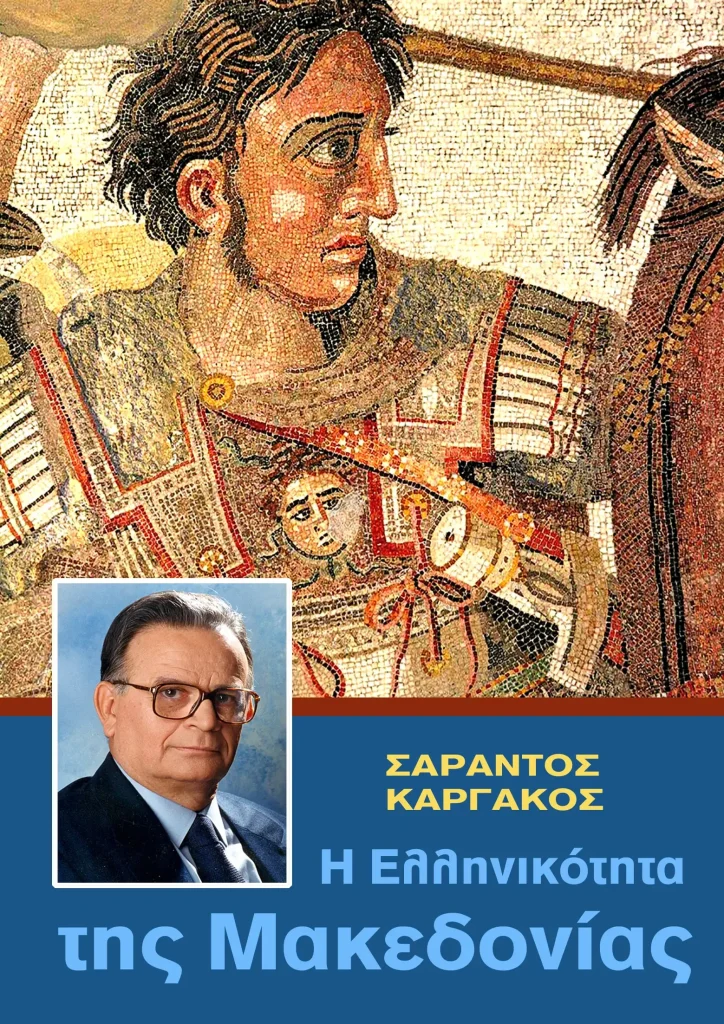
Sarantos Kargakos
Until recently, no continuous text of the ancestral language of the Macedonians was preserved, only individual words (“languages”) and nouns. Macedonian literary works as well as continuous epigraphic texts appear mainly in the 4th century BC, by which time the “Koine” had already prevailed. This explains why the identification of the Macedonian dialect gave rise to intense scientific disputes, which were exacerbated by political considerations.
Recently, however, the systematic collection from the inscriptions of elements that do not belong to the official “common” but to the colloquial language, the study of the anthroponyms, which are formed from prefixes, and finally the discovery of continuous epigraphic texts, such as the katadesmos of Pella, proved that Macedonian was a Greek dialect related to those of Epirus and Thessaly. Elements of it entered the “Koine” and prevailed in the modern Greek dialects.
For a long time the Macedonian dialect coexisted with other languages of earlier populations which it eventually displaced. From these, of which we know very little, we assume that it inherited a few prefixes and anthroponyms, and perhaps a particular way of pronouncing certain consonants.
In the late Archaic period, with the spread of the Persian state in Europe, the influence of the Ionian colonies on the coast was strengthened and the Eastern Ionian alphabet spread to Macedonia.
The influence of the language and culture of Athens, which was dynamically present on the Macedonian coast, was also decisive from the early classical period.
In the 4th century BC the local dialects were adapted to Attic, which was adopted as the official language by Philip II, and formed into the so-called “Koine”.
Not many details are known about the language of Macedonia in Byzantine times, but it must have followed the general developments of this period, which was decisive for the history of the Greek language. Already in Late Antiquity the last traces of the ancient Macedonian dialect have disappeared.
At the same time, the first features of the modern Macedonian dialects appear in the “Koine”, which has replaced the local dialect. The latter must have been fully formed around the 10th century, although there is no written evidence to prove this with certainty. These dialects are used only in the spoken word, while the official language of the state remains the oldest form of ‘Koine’, which is increasingly different from the spoken language, as in the rest of Greece.